
Lefebvrists, Vatican Decrees Excommunication: New Schism After 38 Years
Bishops Alfonso de Galarreta and Bernard Fellay, together with the four priests consecrated at Écône without a papal mandate, have been excommunicated. The Dicastery for the Doctrine of the Faith warns: confessions and marriages are invalid. Lay faithful who formally adhere to the schism may also face excommunication
VATICAN CITY — The Vatican has formally declared the excommunication of the six bishops of the Priestly Society of Saint Pius X involved in episcopal consecrations celebrated on 1 July at Écône, Switzerland, without the Pope’s mandate and against the express will of the Holy See.
The measure concerns Alfonso de Galarreta, the principal consecrating bishop; Bernard Fellay, the co-consecrator; and the four priests ordained as bishops: Swiss priest Pascal Schreiber, American priest Michael Goldade, and French priests Michel Poinsinet de Sivry and Marc Hanappier.
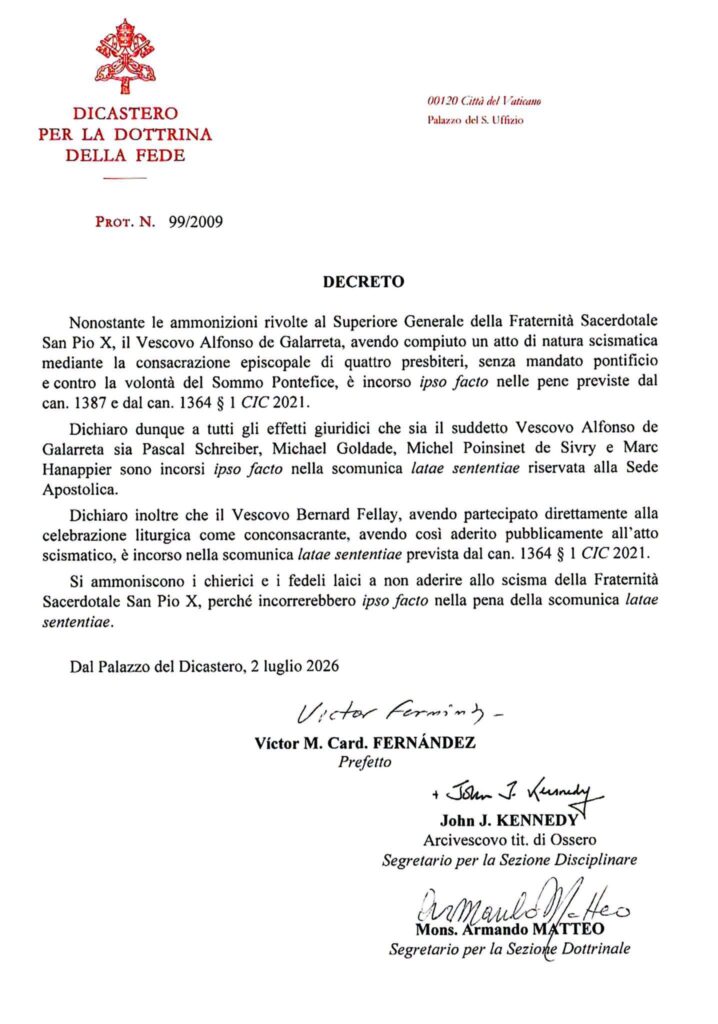
According to the decree signed by Cardinal Víctor Manuel Fernández, Prefect of the Dicastery for the Doctrine of the Faith, all six incurred excommunication automatically, ipso facto and latae sententiae, after taking part in what the Vatican described as “an act of a schismatic nature.”
The penalty, reserved to the Apostolic See, was incurred because the bishops proceeded with the ordinations without a pontifical mandate.
The decision marks the most serious rupture between Rome and the traditionalist movement founded by French Archbishop Marcel Lefebvre since the illicit episcopal consecrations of 30 June 1988.
The ceremony at Écône
The consecrations took place at the international seminary of the Society of Saint Pius X in Écône, in the Swiss canton of Valais.
The liturgy began on the morning of 1 July inside a large white structure erected beside the seminary. More than a thousand priests, men and women religious, and approximately 15,000 lay faithful reportedly attended the ceremony, which was also broadcast internationally through channels linked to the Society.
Images released by the Society showed the laying on of hands upon the four priests, followed by the consecratory prayer, the presentation of the episcopal insignia and the celebration of Mass according to the traditional rite.
The ceremony was presided over by Alfonso de Galarreta, assisted by Bernard Fellay. Both men were themselves consecrated bishops by Marcel Lefebvre in 1988 and are the last two surviving bishops among the four ordained at that time without the authorisation of Pope John Paul II.
The Society said the four new prelates would serve as auxiliary bishops without territorial jurisdiction. Their role would be to ensure the continuation of priestly ordinations, confirmations and the Society’s wider pastoral activities.
The Society acknowledged that the consecrations had taken place without papal approval, but argued that it had acted because of what it considers to be “exceptional circumstances.”
The decree of the Doctrine of the Faith
The Dicastery for the Doctrine of the Faith ruled that de Galarreta, as the principal consecrating bishop, had incurred the canonical penalties established for both episcopal consecration without a papal mandate and the offence of schism.
The same consequences apply to the four newly ordained bishops.
Bernard Fellay was also declared excommunicated because he participated directly in the liturgical celebration as co-consecrator and publicly associated himself with the schismatic act.
A latae sententiae excommunication is not imposed only after a trial or a formal sentence. Under canon law, it is incurred automatically at the moment a person knowingly commits the act to which the penalty is attached.
The Vatican decree formally confirms that the penalty has been incurred and makes its legal consequences public.
The six bishops may therefore not lawfully administer the sacraments, hold ecclesiastical office or participate fully in the sacramental life of the Catholic Church unless the penalty is eventually lifted by the Holy See.
Vatican: the Society is in schism
The significance of the decision extends beyond the six bishops.
In an explanatory note issued alongside the decree, the Dicastery stated that sacred ministers belonging to the Society of Saint Pius X must now be considered to be in a situation of schism and subject to the excommunication established under canon law.
For Rome, the new consecrations are therefore not merely a serious act of disciplinary disobedience. They represent a rupture of ecclesial communion based on the practical rejection of the Pope’s primacy in the appointment and ordination of bishops.
The Dicastery referred to the position adopted by Pope John Paul II following the 1988 consecrations. At that time, the Vatican stated that ordaining bishops without a papal mandate, despite an explicit prohibition from the Holy See, constituted a schismatic act because it affected an essential element of the Church’s unity and apostolic succession.
What happens to lay faithful
The decree also contains a warning addressed to clergy and lay faithful: those who adhere to the schism may automatically incur excommunication.
The Vatican’s explanatory note nevertheless clarifies that, in the case of lay Catholics, formal adherence to the Society and to its separation from Rome must be demonstrated.
Occasional attendance at a celebration or isolated participation in one of the Society’s activities is therefore not, by itself, sufficient to determine automatic excommunication.
Individual situations will have to be assessed according to the criteria established in a 1996 document issued by the Pontifical Council for Legislative Texts, which is expressly recalled in the new Vatican measure.
Canonical responsibility will depend upon the person’s awareness and deliberate intention to associate themselves permanently with the separation from the Church governed by the Roman Pontiff.
The Vatican has nevertheless urged all Catholics to refrain from participating in celebrations and activities promoted by the Society of Saint Pius X and to remain in full communion with the Pope and with the bishops united to him.
Confessions and marriages declared invalid
One of the most significant consequences concerns the administration of the sacraments.
The Dicastery for the Doctrine of the Faith stated that ministers of the Society administer the sacraments illicitly. It also declared that, in the new situation created by the schism, confessions heard by its priests and marriages witnessed by them are invalid.
The distinction between validity and lawfulness is important.
An illicit sacrament is celebrated in violation of Church law but may still produce its sacramental effects. An invalid sacrament, by contrast, is considered not to have been validly administered at all.
The decision substantially alters the pastoral situation created during the previous decade.
In 2016, Pope Francis had granted priests of the Society the faculty to validly administer the Sacrament of Penance. In 2017, the Vatican also permitted diocesan bishops, under certain circumstances, to delegate priests of the Society to validly witness marriages.
Following the schismatic act of 1 July 2026, however, the new Vatican decree states that confessions and marriages celebrated by ministers of the Society without the required faculties are invalid.
The sacramental validity of the episcopal consecrations themselves is not being denied.
According to Catholic theology, a validly ordained bishop can validly confer episcopal ordination, even when doing so gravely violates Church law and takes place against the will of the Pope.
The four priests are therefore considered to have become bishops sacramentally, but they are excommunicated and possess no canonical mission recognised by Rome.
Pope Leo XIV’s final appeal
Before the consecrations, Pope Leo XIV had made a final appeal to the Society’s Superior General, Father Davide Pagliarani.
In a letter dated 29 June, the Pope acknowledged the attachment of the Society’s faithful to the traditional liturgy, priestly formation and the Church’s Tradition, but strongly urged its leaders to abandon the planned ordinations.
“Turn back,” the Pope reportedly wrote, warning that the act would provoke a new division and deprive the faithful of the lawful — and in certain cases valid — reception of the sacraments.
The appeal did not change the Society’s decision.
Pagliarani argued that the consecrations were necessary to guarantee the survival of the movement and the continued transmission of the traditional liturgy and doctrine.
During the ceremony, he said the Society was prepared to endure any consequence in order to continue what it considers its mission within the Church.
The Society maintains that the canonical sanctions are without effect because, in its view, the ordinations were justified by a state of necessity. Rome rejects that interpretation and regards the decision as a deliberate rupture of communion with the Successor of Peter.
The precedent of 1988
The new crisis closely mirrors what happened 38 years ago.
On 30 June 1988, Marcel Lefebvre consecrated four bishops at Écône without a mandate from Pope John Paul II: Bernard Fellay, Alfonso de Galarreta, Bernard Tissier de Mallerais and Richard Williamson.
The Pope described the ordinations as a schismatic act and declared the excommunication of Lefebvre, co-consecrating Bishop Antônio de Castro Mayer and the four newly ordained bishops.
In January 2009, Pope Benedict XVI lifted the excommunication of the four bishops who were still alive at the time. The decision was intended as a gesture favouring reconciliation and the resumption of doctrinal dialogue.
The lifting of the penalty did not, however, amount to canonical recognition of the Society, nor did it resolve its disagreements with Rome.
Contacts continued over the following years on the most disputed issues: the authority of the Second Vatican Council, religious freedom, ecumenism, interreligious dialogue and the liturgical reforms.
In February 2026, the Holy See had reportedly proposed a renewed process of theological discussion, conditional upon the suspension of the episcopal consecrations.
The Society rejected the request, maintaining that the conditions did not exist for an agreement on the underlying doctrinal questions.
An open wound within the Church
The decision taken at Écône opens a new and particularly difficult phase.
Previously, the Society existed in an irregular canonical situation, while pastoral concessions and attempts at dialogue remained in place. The Vatican is now speaking explicitly of schism and is urging Catholics not to participate in the Society’s activities.
The Holy See has nevertheless left the door open to reconciliation.
The explanatory note from the Dicastery for the Doctrine of the Faith states that the Church will welcome with sincere concern and pastoral care any priests or faithful who wish to return to full communion.
Apostolic nuncios are expected to prepare procedures that local bishops may use to examine individual cases and accompany those who decide to leave the Society.
After almost four decades of meetings, concessions and attempts at reconciliation, the events of 1 July have brought relations between Rome and the Lefebvrists back to the most dramatic point in their history.
For the Society, the consecrations guarantee its continuity.
For the Vatican, they constitute a rejection of the authority of the Successor of Peter and a new rupture in the unity of the Catholic Church.
The post Lefebvrists, Vatican Decrees Excommunication: New Schism After 38 Years first appeared on Allora! Italian Australian News.
Qual è la tua reazione?
 Mi piace
0
Mi piace
0
 Antipatico
0
Antipatico
0
 Lo amo
0
Lo amo
0
 Comico
0
Comico
0
 Wow
0
Wow
0
 Triste
0
Triste
0
 Furioso
0
Furioso
0

Redazione Eventi e News









Commenti (0)